
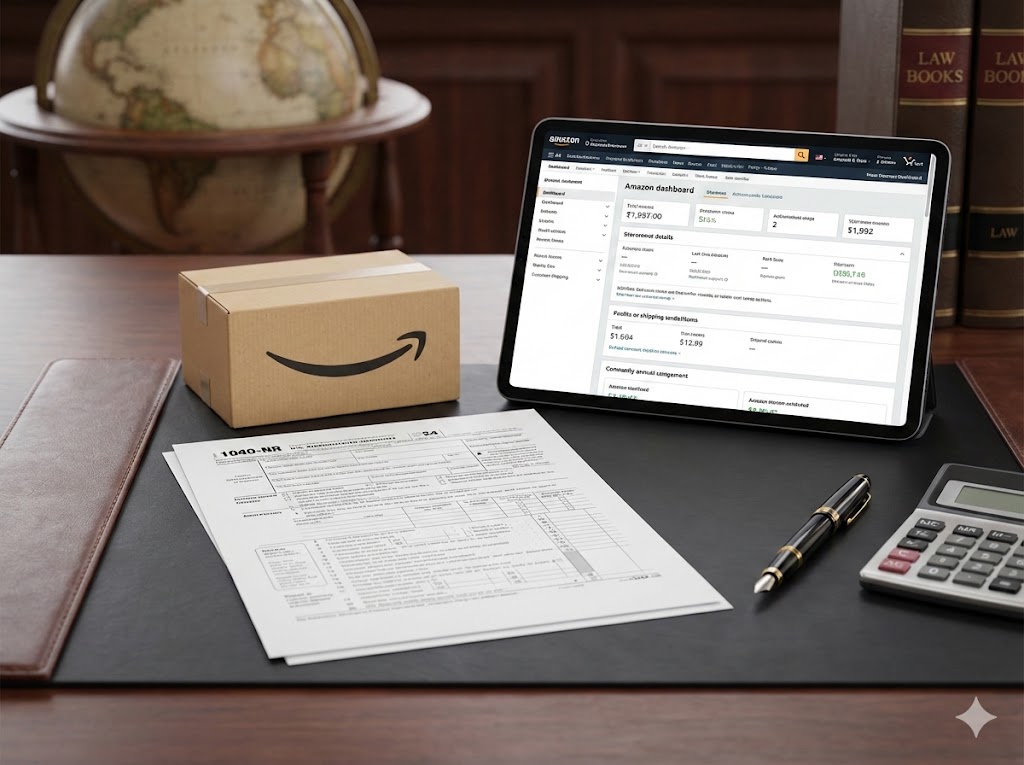
Introduction: The Invisible Border of E-Commerce
In my twenty years of practicing international tax law, I have witnessed the evolution of the “Global Marketplace” firsthand. I often tell my clients that while Jeff Bezos has made it incredibly easy to sell products in the United States, the Internal Revenue Service (IRS) has made it equally complex to keep the profits.
The most frequent question I receive from entrepreneurs in Turkey, the EU, and the Middle East is: “I don’t live in the U.S., and I don’t have an office there. Why should I pay taxes to the American government?”
The answer lies in the concept of Sovereign Economic Jurisdiction. If you are extracting wealth from the American consumer using American infrastructure (like Amazon’s warehouses), the U.S. government wants its share. This guide serves as a masterclass in navigating these waters without sinking your business.
Part I: The Foundation—Are You “ETBUS”?
To understand your tax liability, we must first define your status. In U.S. tax law, the “Golden Rule” for non-residents is the concept of being Engaged in a Trade or Business in the United States (ETBUS).
The Three Pillars of ETBUS
For a non-resident to be considered ETBUS, their activities must be:
-
Considerable: Not just a one-time sale.
-
Continuous: Regular business operations.
-
Regular: A sustained presence in the market.
If you are an Amazon seller using Fulfillment by Amazon (FBA), you are almost certainly ETBUS. Why? Because your inventory—physical assets—is sitting in a warehouse in places like New Jersey, California, or Texas. You are utilizing American labor (Amazon employees) and American logistics to generate profit.
The Consequences of ETBUS Status
Once you are deemed ETBUS, all income “effectively connected” with that business (Effectively Connected Income or ECI) is subject to U.S. federal income tax. You are no longer just a “foreigner selling a book”; you are a business operator within the U.S. economic zone.
Part II: The FBA Trap—Physical vs. Economic Nexus
Many sellers confuse Income Tax (Federal) with Sales Tax (State). As a lawyer, I see this confusion lead to massive audit triggers.
1. State Sales Tax and the Wayfair Doctrine
Since the 2018 South Dakota v. Wayfair Supreme Court decision, states have the power to tax you based on Economic Nexus. If you sell more than $100,000 or have 200+ transactions in a state (the threshold varies), you must register for a Sales Tax Permit.
-
Marketplace Facilitator Laws: Fortunately, Amazon now collects and remits sales tax for most states.
-
The Hidden Danger: Even if Amazon collects the tax, some states (like Pennsylvania or Washington) may still require you to register because your FBA inventory creates a “Physical Nexus.”
2. Federal Income Tax (The IRS Level)
This is where the Form 1040-NR comes into play. Even if you don’t owe “Sales Tax” because Amazon handles it, you still owe “Income Tax” on your net profit.
Part III: The U.S. LLC Strategy—Shield or Target?
A trend I’ve noticed over the last decade is the rush to open Wyoming or Delaware LLCs. While these are excellent tools for opening U.S. bank accounts, they are often misunderstood.
The Disregarded Entity
If you are a single owner of a U.S. LLC, the IRS treats the LLC as “transparent” or “disregarded.” This means the LLC itself doesn’t pay taxes; you do, as an individual, on Form 1040-NR.
The $25,000 Nightmare: Form 5472
If you own a U.S. LLC, you are subject to Section 6038A. You must file Form 5472 to report “Reportable Transactions” between the foreign owner and the LLC.
Attorney’s Warning: The penalty for failing to file this information return is now $25,000. I have seen small sellers lose their entire year’s profit because they forgot this one simple form.
Part IV: Utilizing Tax Treaties (The Turkey & Netherlands Example)
If you are lucky enough to be a tax resident of a country with a U.S. Treaty, you have a powerful defense: The Permanent Establishment (PE) Clause.
The PE Defense
Under many treaties (such as the U.S.-Turkey or U.S.-Netherlands treaties), business profits are only taxable in the U.S. if you have a Permanent Establishment (a fixed office, a branch, or a dependent agent) in the U.S.
-
The Argument: We argue that Amazon FBA is an independent agent and a warehouse is not a fixed place of business for the seller.
-
The Mechanism: To claim this, you must file Form 8833 along with your 1040-NR.
What about UAE or Saudi Sellers?
If your country does not have a tax treaty with the U.S., you cannot use the PE defense. You are taxed from the very first dollar of profit at graduated U.S. rates. This is why many Middle Eastern sellers choose to incorporate in treaty-friendly jurisdictions.
Part V: Essential Documentation and Forms
To remain compliant, an international Amazon seller must master this “Alphabet Soup” of forms:
| Form | Name | Purpose |
| W-8BEN | Certificate of Foreign Status | Tells Amazon: “I am a foreigner, do not withhold 30% of my sales.” |
| SS-4 | EIN Application | Used to get your Employer Identification Number. |
| 1040-NR | Non-Resident Return | Your actual tax return where you calculate profit/loss. |
| Schedule C | Profit or Loss from Business | Where you list your Amazon fees, COGS, and ads. |
| Form 8833 | Treaty Disclosure | Explains why you are exempt under a treaty. |
| Form 5472 | Information Return | Required if you have a U.S. LLC. |
Part VI: Deductions—The Secret to Lowering the Bill
One of the benefits of filing a 1040-NR (as opposed to being hit with a flat 30% withholding) is the ability to claim deductions. You are only taxed on Net Profit.
As an experienced attorney, I ensure my clients deduct every legal cent:
-
Cost of Goods Sold (COGS): The price you paid for the inventory.
-
Amazon Fees: Referral fees, FBA storage, and shipping.
-
Marketing: Every dollar spent on Amazon PPC (Pay-Per-Click).
-
Software: Subscriptions to Helium10, Jungle Scout, or accounting tools.
-
Professional Fees: My legal fees and your accountant’s fees are fully deductible.
-
Home Office: In some cases, a portion of your international home office used exclusively for the U.S. business can be pro-rated (though this is a “grey area” that requires careful documentation).
Part VII: The “Protective Filing” Strategy
I always advise my clients to file what we call a Protective Return.
Suppose you believe you owe $0 in tax because of a treaty. You might be tempted to file nothing. This is a mistake. If the IRS disagrees with you three years later and you haven’t filed a return, they can:
-
Deny all your deductions (taxing you on Revenue, not Profit).
-
Assess penalties for “Failure to File.”
-
Freeze your Amazon disbursements via a levy.
By filing a “Zero-Tax” protective return today, you start the 3-year Statute of Limitations. Once that clock runs out, the IRS generally cannot come back to haunt you.
Conclusion: Compliance is an Investment, Not a Cost
In the world of international e-commerce, your most valuable asset is not your product—it is your access to the U.S. market. Risking that access by ignoring tax laws is, in my professional opinion, a poor business strategy.
The IRS is becoming increasingly sophisticated. With the rise of digital reporting and data sharing between Amazon and the government, “hiding” is no longer an option. True success comes from building a compliant, transparent business that can scale without the fear of a $25,000 penalty or a frozen account.
Final Legal Checklist for Amazon Sellers:
-
[ ] Do you have an EIN?
-
[ ] Is your W-8BEN up to date on your Seller Central?
-
[ ] Have you determined if your home country has a Tax Treaty?
-
[ ] Are you tracking your “Cost of Goods Sold” meticulously?
-
[ ] If you have an LLC, have you prepared your Form 5472?